Cat Litter Packaging Plant: From 500 to 1,200 Bags per Hour
When a company's growth runs up against the physical limits of its production line, the only solution is to rethink the way it works.
That is exactly what happened to a cat litter manufacturer that turned to MF TECNO to replace an old semi-automatic and manual setup with a turnkey plant.
The result? A leap from 500 to 1,200 bags per hour.
A 140% increase in production capacity, achieved without having to expand departments or add extra shifts.
In this case history we retrace the stages of the project: how the new line came about, the challenges overcome and the goals achieved in terms of efficiency, operator safety and return on investment.
The starting point: semi-automatic bagging and manual palletizing at 500 bags/hour
Before the project, packaging relied on two elements: a semi-automatic bagging machine and an operator who built the pallets by hand, bag after bag. The line ran on two shifts and produced around 500 bags per hour.
It was a hard threshold to exceed, and the reason was not technical. On a line of this kind, speed depends on the pace of the person loading the bags and, above all, of the person lifting them and placing them on the pallet. Beyond a certain point you cannot ask people to go faster: you can only add more people, or change the way you work.
Meanwhile, the market was asking for something else. According to research by Grand View Research published in 2026, the cat litter market will grow at a compound annual rate of 5.5% until 2033. This considerable growth is driven by the spread of pet ownership, especially in urban areas, and by consumers who are increasingly focused on hygiene, convenience and sustainability.
For the manufacturer, staying stuck at 500 bags per hour meant being unable to keep pace with demand.
The objective: more capacity with 4 products and 3 block-bottom bag sizes
The project had to meet two requirements that are often at odds with each other: producing much more and, at the same time, handling a wide range of SKUs on the same line.
The customer packs four product lines, each with a different density, in three sizes: Small, Medium and Large, with weights ranging from 3.6 to 9.8 kg (approx. 7.9 to 21.6 lb).
All in block-bottom paper bags, with or without side handles: a practical pack for the end consumer and well suited to transport and storage, but one that calls for different packaging and palletizing technology compared to a traditional system.
Each size also requires its own palletizing pattern.
The solution: an automatic bagging, bundling, palletizing and wrapping line
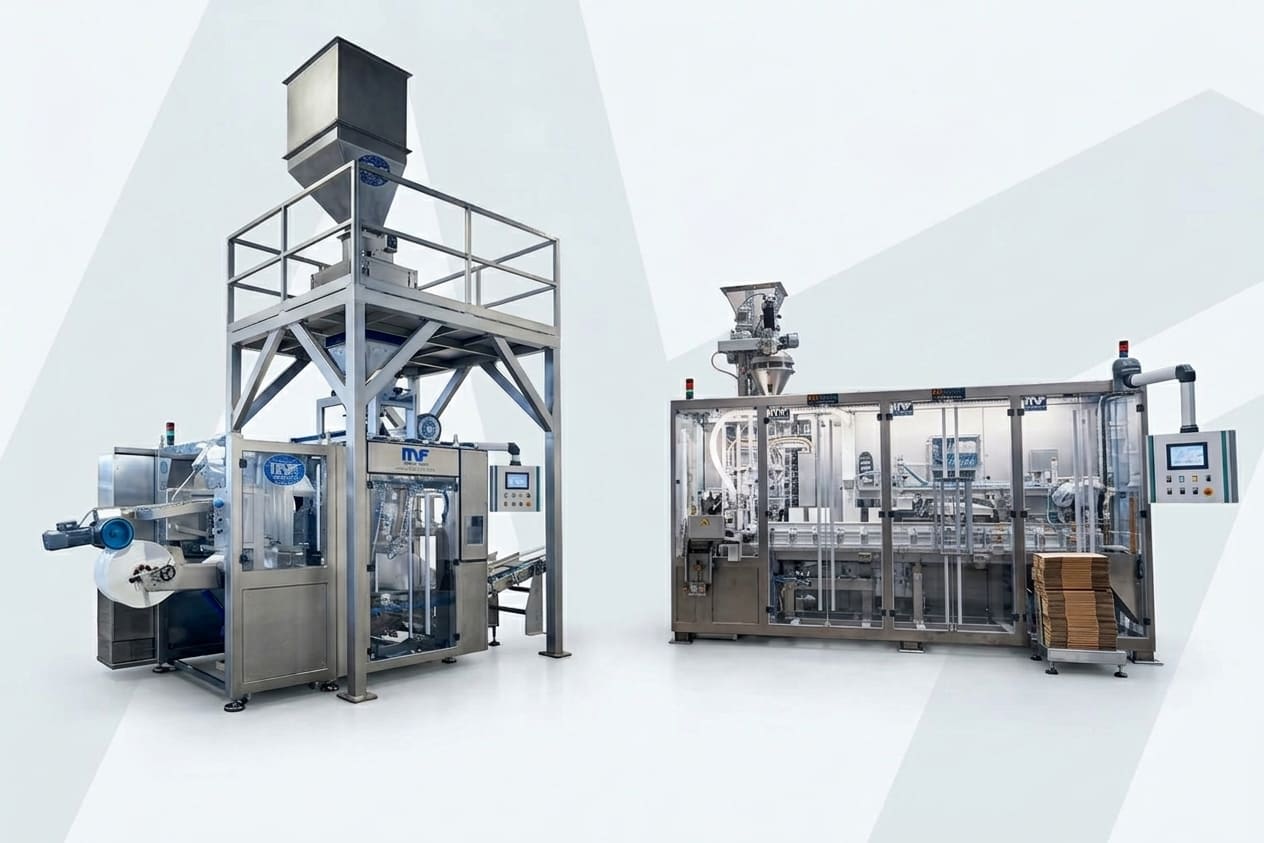
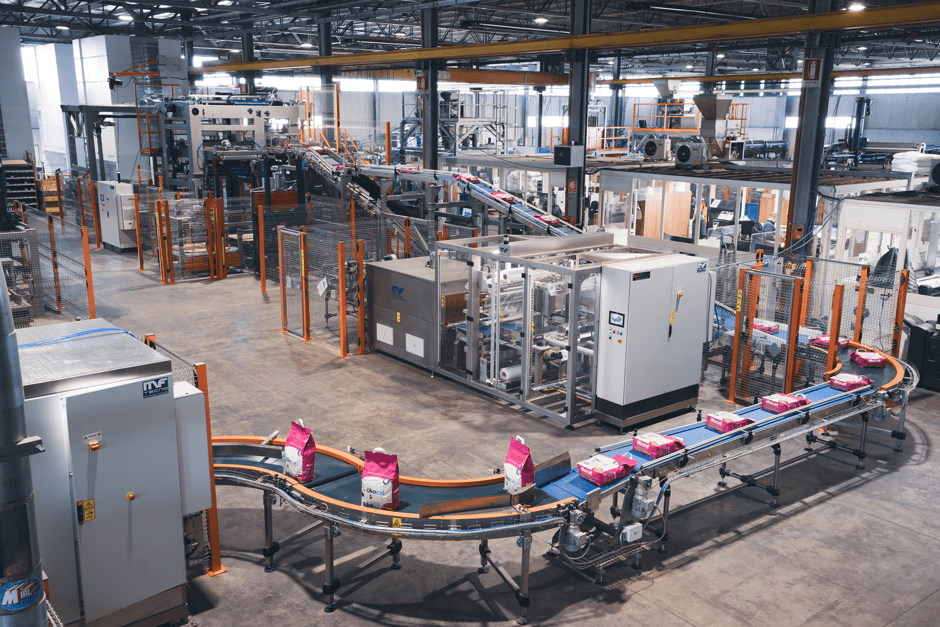
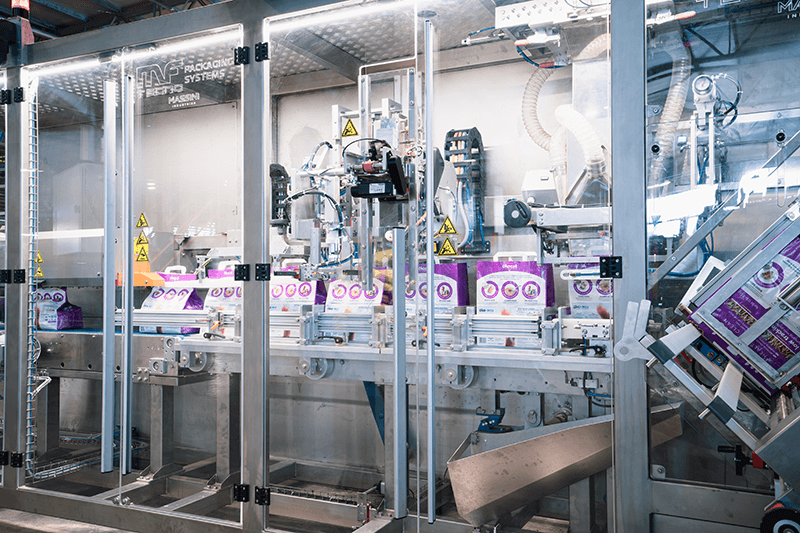
MF TECNO designed and built the entire line using machines of its own manufacture, sized for the required speed and the variety of formats:
Bagging machine SBS 1200
Bundling machine MF Bundlee-V
Cartesian palletizer PRC 1000 with 6 columns
Rotating-arm stretch wrapper MF Wrap 60
Bagging: SBS 1200
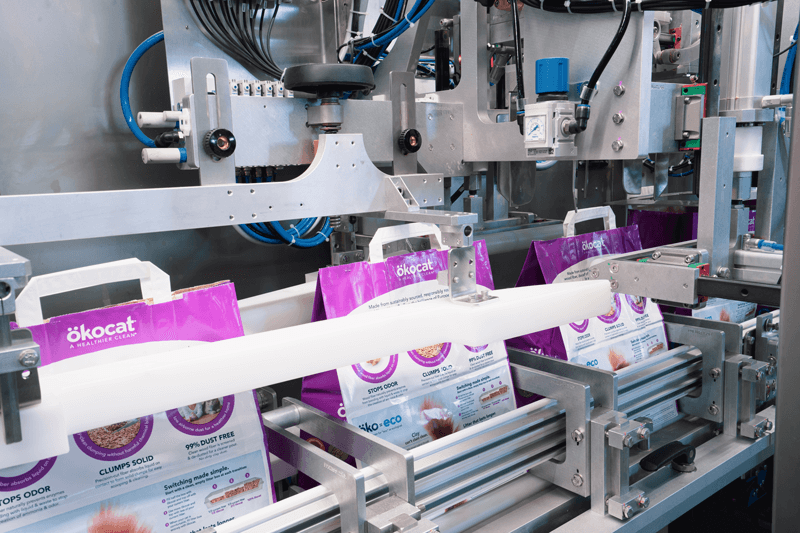
The heart of the line is the SBS 1200 bagging machine, which can handle block-bottom bags of up to 15 kg (33 lb). It is the machine that sets the pace for the whole plant, and it made it possible to move from an operator-dependent process to a continuous automatic cycle.
The same machine handles all sizes and all product lines, even with very different densities, while maintaining high dosing accuracy.
It can be supplemented with labeling machines and different closing systems, while the touch-screen panel and self-diagnostics make the operator's job and size changeovers easier.
Format sorting and bundling: MF Bundlee-V
Downstream of the bagging machine, the line splits. Small sizes are sent to the MF Bundlee-V bundling machine, which groups them upright into shrink-wrapped multipacks, at up to 10 bundles per minute. It is a solution designed for retail and for keeping small, light packs stable on the pallet.
The machine is made entirely of stainless steel, a choice well suited to the dusty environments typical of cat litter production.
Larger sizes, meanwhile, continue along dedicated conveyors straight to the palletizer.
Palletizing: PRC 1000 with 6 columns
The6-column Cartesian palletizer is the machine that removed the real bottleneck of the old line. It handles up to 1,200 bags per hour with a single grip and up to 2,000 with a double grip.
It automatically builds the layers according to the pattern set for each size, managed by a PLC.
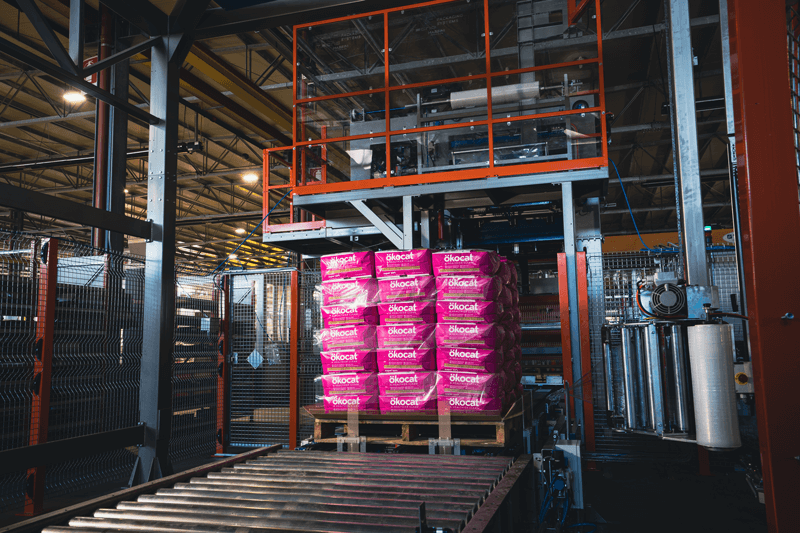
Bags can be partially overlapped, end-to-end or side-by-side, and pressed vertically and horizontally; side compactors and reel-fed interlayer sheets complete the load.
The result is stable, uniform pallets that are always identical from one shift to the next.
Wrapping: MF Wrap 60
At the end of the line, the MF Wrap 60 rotating-arm stretch wrapper, suitable for loads of up to 2,000 kg (4,400 lb), secures the pallet with stretch film so that it reaches its destination intact.
The finished pallet is then ready to be picked up and moved to the warehouse.
The result: from 500 to 1,200 bags/hour with the same number of shifts
The new line produces 1,200 bags per hour, compared to the original 500: an increase of 140%. In other words, on the same number of shifts, the manufacturer now packs more than twice as many bags as before.
The result is not only about speed.
An automatic line works at a steady pace from the start to the end of the shift, without the slowdowns caused by fatigue, and delivers uniform pallets regardless of who is on duty.
For those who have to plan production and shipments, this predictability is worth as much as the extra bags.
Same team, +140% output: what changes for operators
The line is still run by a team similar to the one before.
What changes is their work: operators no longer lift bags or build pallets by hand; instead, they supervise an automatic plant, monitor its operation and handle size changeovers.
The economic effect is intuitive even without going into the figures.
If the headcount stays the same and output more than doubles, the labor cost of each individual bag falls by more than half.
It is one of the most tangible ways to measure the value of automation: not how many people you save, but how much each hour of work yields.
Safety and ergonomics: eliminating manual bag handling
On the old line, every bag was lifted and set down by hand.
With packs weighing almost 10 kg (22 lb) and a pace of hundreds of bags per hour, manual palletizing meant continuous, repetitive lifting for the entire shift: one of the most physically demanding tasks in the entire plant.
For a company, the risk is not limited to injuries and their direct costs.
A task with high physical wear and tear leads to absences and employee turnover, and it is becoming increasingly hard to find people willing to do it: in many plants it is precisely this, more than speed, that makes a manual line fragile.
A plant like the one described tackles the problem at its root: it eliminates manual lifting rather than merely reducing it.
Bagging, bundling, palletizing and wrapping are all automatic, within areas protected by guards and safety devices, and the operator moves from a physically strenuous role to a supervisory one.
What the investment returns: how to read the ROI
The return on an automatic line is not measured solely in hours of labor saved. There are at least four items to consider:
Margin on additional volumes: the extra 700 bags per hour are salable product that did not exist before;
Labor cost per bag: with the same team, it falls by more than half;
Avoided costs: absences, injuries and employee turnover linked to manual handling;
Quality and logistics: uniform, stable pallets reduce product damage and disputes upon delivery.
The weight of each item depends on the product margin and the number of shifts: that is why our technical department carries out the analysis for each specific case.
A single supplier from design to after-sales service
The bagging machine, bundling machine, palletizer and stretch wrapper are all designed and manufactured by MF TECNO.
The customer had a single point of contact for design, installation and commissioning, and a line in which the machines communicate with each other and can be monitored centrally.
One partner fully responsible from the design stage through to after-sales service and spare parts.
The plant was also custom-designed to fit the existing layout.
Scalability: up to 2,000 bags/hour without changing the palletizing
A less visible aspect, but a decisive one in the long term, is the sizing of the end of line.
In double-grip configuration, the 6-column palletizer can reach up to 2,000 bags per hour: if the manufacturer wanted to increase volumes further in the future, it could do so by upgrading the bagging stage, without rethinking the palletizing.
Automation also shifts the focus to what happens after the line.
With output more than doubled, pallets come off the line at a much faster rate, and warehouse logistics must be organized accordingly.
This is one of the aspects we assess together with the customer at the design stage: an efficient line is only truly efficient if everything around it can keep up.
The plant is designed to ensure maximum responsiveness to changing demand.
Choosing this model makes it possible to increase the productivity of the packaging section, so as to adapt promptly to new volumes and market scenarios.
Conclusion
Going from 500 to 1,200 bags per hour was not just an increase in speed. For this cat litter manufacturer, it meant breaking free of a physical limit, taking the most strenuous work off people's shoulders and building a line capable of keeping pace with market growth.
Relying on a single, fully responsible partner eliminates disputes over responsibility and ensures fast, efficient after-sales service and spare parts supply.
Frequently asked questions
How many bags per hour does the new cat litter packaging line produce?
The line produces 1,200 bags per hour, compared to 500 on the previous semi-automatic setup: an increase of 140% on the same number of shifts. The 6-column Cartesian palletizer is already sized to reach up to 2,000 bags per hour with a double grip.
What bag sizes can the plant handle?
The plant handles block-bottom paper bags, with or without side handles, in three sizes (Small, Medium and Large) from 3.6 to 9.8 kg (approx. 7.9 to 21.6 lb). The SBS 1200 bagging machine handles bags of up to 15 kg (33 lb) and maintains high dosing accuracy across four product lines with different densities.
Does increasing output require more operators or more shifts?
No. The line is run by a team similar to the previous one and works the same two shifts. What changes is the operators' role: they no longer lift bags but supervise the plant and handle size changeovers. With the same people and output more than doubled, the labor cost per bag falls by more than half.
How does operator safety improve compared to manual palletizing?
The line eliminates manual lifting of bags rather than merely reducing it. Bagging, bundling, palletizing and wrapping are all automatic, within areas protected by guards and safety devices. This reduces the risk of injury, as well as the absences and employee turnover linked to one of the most physically demanding tasks in the plant.
How do you calculate the return on investment of an automatic bagging and palletizing line?
There are at least four items to consider: the margin on additional volumes, the reduction in labor cost per bag, the costs avoided in absences, injuries and employee turnover, and the quality and logistics benefits of uniform, stable pallets. The weight of each item depends on the product margin and the number of shifts, which is why the MF TECNO technical department carries out the analysis for each specific case.
What is the bundling machine for in a cat litter packaging line?
The MF Bundlee-V bundling machine groups small-size bags upright into shrink-wrapped multipacks, at up to 10 bundles per minute. This means small, light packs are ready for retail and stay stable on the pallet. The machine is made of stainless steel, well suited to the dusty environments typical of cat litter production.
Can the line grow if volumes increase further?
Yes. With a double grip, the 6-column palletizer reaches up to 2,000 bags per hour: to increase output further, it is enough to upgrade the bagging stage, without rethinking the palletizing. At the design stage, MF TECNO also assesses warehouse logistics downstream of the line together with the customer.
Why choose a single supplier for the whole packaging line?
The bagging machine, bundling machine, palletizer and stretch wrapper are all designed and manufactured by MF TECNO. The customer has a single point of contact for design, installation, commissioning, after-sales service and spare parts, and a line in which the machines communicate with each other and can be monitored centrally. The plant is also custom-designed to fit the existing layout.
FFS tubular bagging machine or open-mouth bagging machine: which one to choose
FFS tubular bagging machine or open-mouth bagger? For anyone packing bulk products in 5–50 kg bags, the choice depends on speed, formats, bag material and product type. A practical guide to comparing the two technologies and finding the MF TECNO solution that best fits your plant.


 FREE QUOTE
 Machinery













 Request information