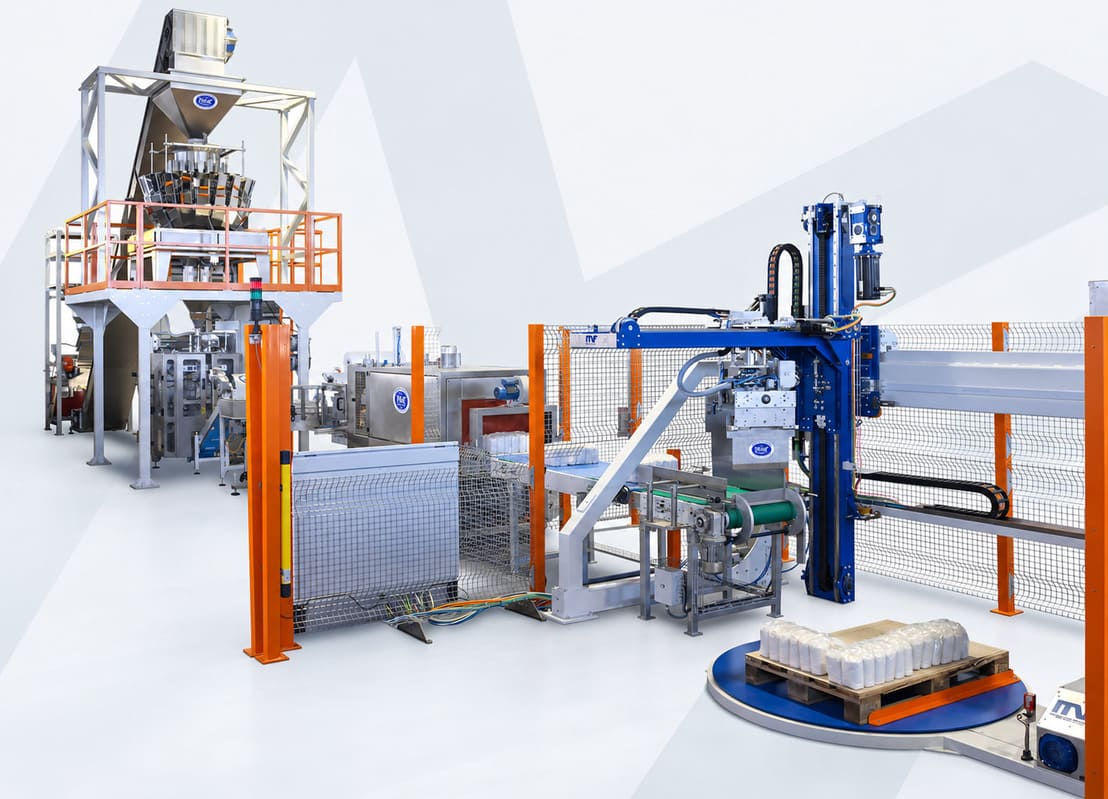
Bagging line for abrasive materials
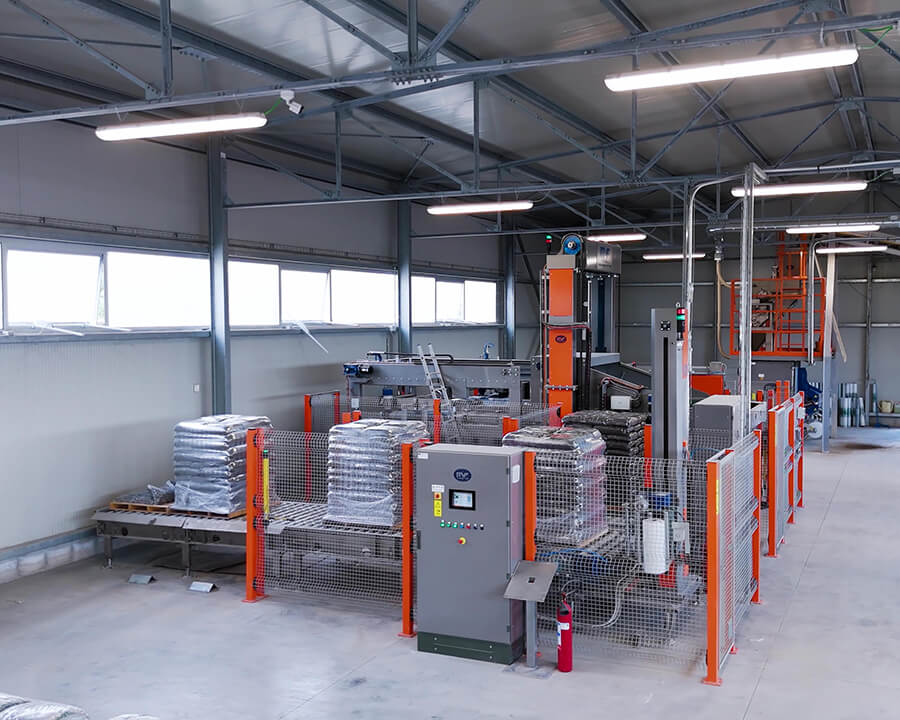
In the bagging of abrasive construction materials such as gravel, pebbles and sand, the challenge is not hitting the required production speed. It is sustaining it over time, across multiple shifts, without constant abrasion compromising bag integrity or forcing unplanned downtime. MF TECNO delivered a complete industrial bagging line for Agrisac, fully engineered and built in-house.
Project overview | Customer | Agrisac |
| Product | Gravel, Pebbles, Sand |
| Operating speed | 1,000 bags/hour |
| Bag weight | 20-25 lbs / 20-25 kg |
| Daily capacity | Up to 8,000 bags/day |
| Daily output | Up to 265 short tons/day |
The technical challenge: wear, dust, uptime
Inert materials generate constant friction and impact loads during filling and transfer. Moisture compounds the mechanical stress and accelerates wear on metal components. In a high-throughput operation, these factors directly affect three variables every plant manager and maintenance engineer tracks closely: service intervals, unplanned downtime and consistent bag quality.
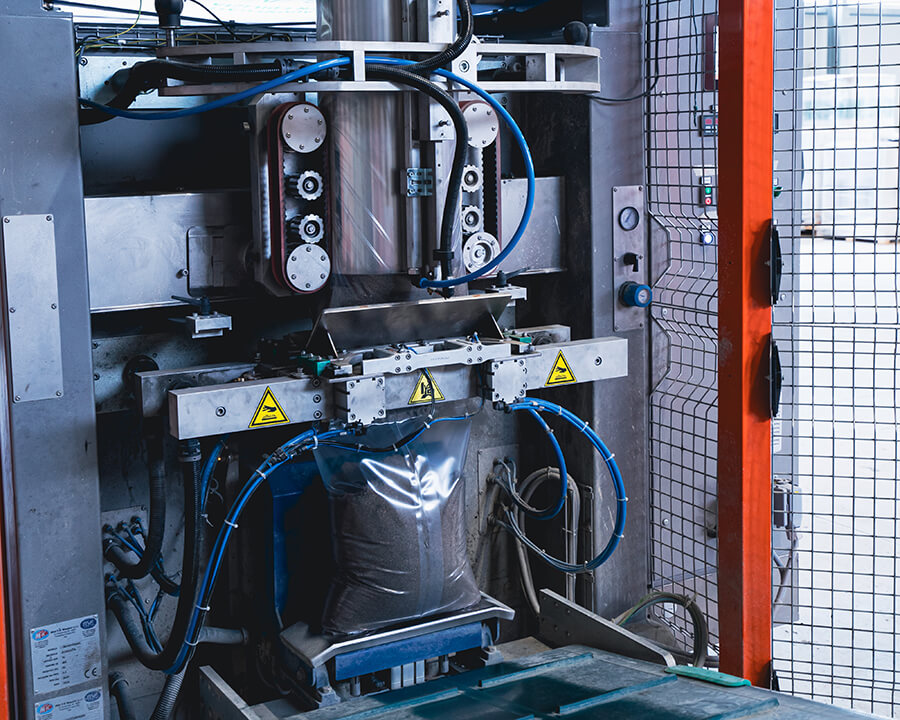
A second issue, frequently overlooked, involves fine dust in the sealing zone. Particles settling on the seal jaw before heat-sealing prevent a clean, uniform bond from forming, resulting in micro-leaks that are invisible to the naked eye but detectable under pallet compression or in transit.
The solution: reinforced design and a fully in-house line
MF TECNO engineered the MF 54 vertical form fill seal machine with targeted upgrades for abrasive materials: elastomeric linings on all product-contact surfaces, anti-wear hopper coating, reinforced cross-seal unit and brushless film drive motor for consistent cycle performance. A dedicated dust extraction module, mounted upstream of the heat-seal station, eliminates seal contamination at the source.
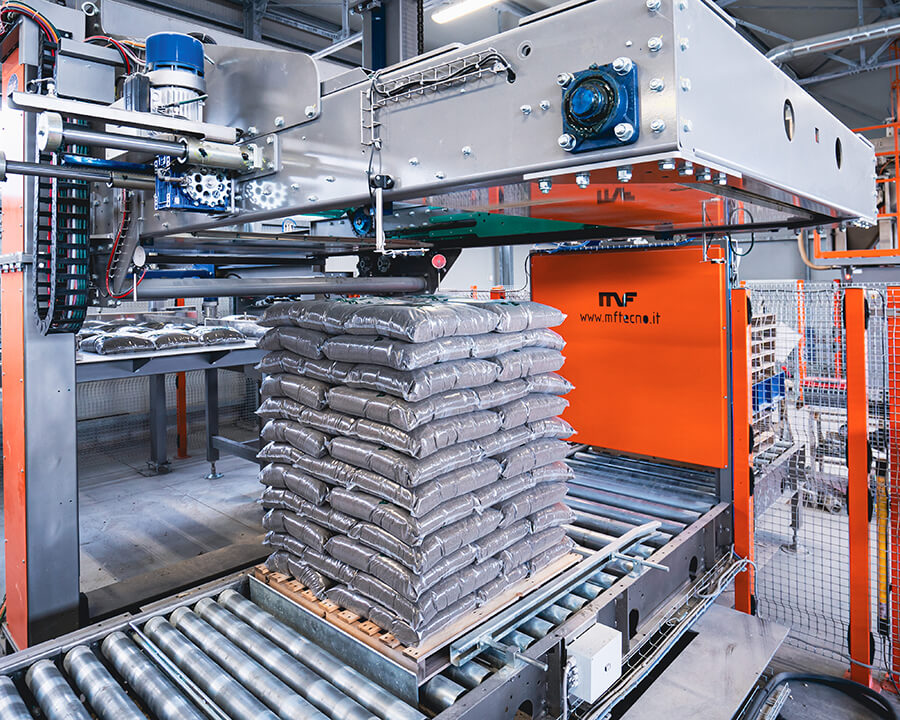
Downstream, the push palletizer handles high-density bags building pallets of 12 layers of 6 bags each. The MF Wrap 35 automatic stretch wrapper closes the line with controlled pre-stretch for secure load containment.
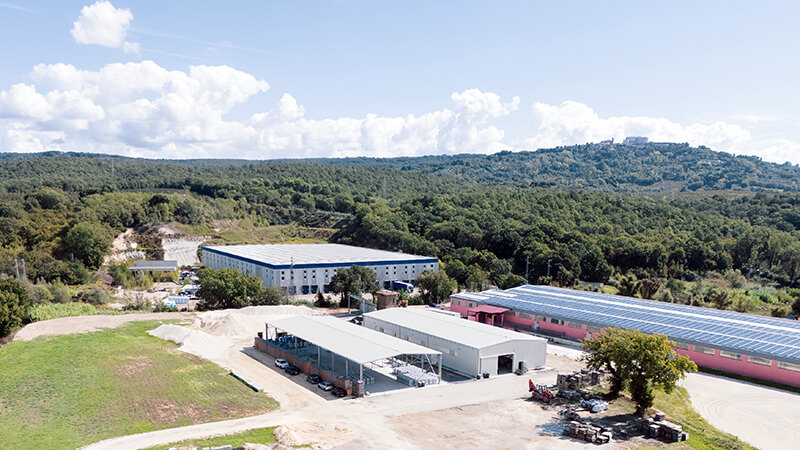
The bagger, palletizer and wrapper are all engineered and manufactured in-house. This eliminates compatibility issues across components from multiple vendors and ensures a single point of contact for equipment, service and spare parts: the real-world condition for faster response times when something needs attention.
Results
- Sustained output of 1,000 bags/hour across extended production runs, with no performance drop over time.
- Fewer unplanned stoppages thanks to a maintenance-first layout: high-wear components are accessible without disassembling secondary parts.
- Consistent seal integrity even with fine dust present, thanks to the extraction module integrated before the heat-seal station.
- Streamlined line management with a single vendor contact for service, repairs and spare parts.
FAQ: Frequently asked questions
1) How do you reduce wear on a vertical bagger running abrasive materials?
The most effective approach targets product-contact surfaces directly. Elastomeric linings on internal components, anti-wear hopper coatings and reinforced seal units slow the rate of mechanical degradation even during extended runs. A brushless film drive motor adds cycle consistency and reduces tension spikes that, over time, accelerate component wear throughout the machine.
2) What causes seal failures when bagging inert construction materials?
The primary cause is dust contamination in the sealing zone. Fine particles generated during filling and transfer settle on the seal jaw before heat-sealing, preventing a clean bond and creating micro-leaks that go undetected until the bag is under load or in transit. A dust extraction module positioned immediately upstream of the heat-seal station is the most direct fix for this issue.
3) Why does single-vendor sourcing matter for an industrial bagging line?
When a line is sourced from multiple vendors, every breakdown starts as a liability dispute before it becomes a repair. Slower response times, integration issues between systems and fragmented spare parts inventories drive up operating costs and make predictive maintenance harder to execute consistently. A single manufacturer who builds the bagger, palletizer and wrapper knows every component and every process variable: that translates to faster diagnosis, targeted fixes and support coverage across the entire line, not just one piece of equipment.
4) What is the real cost of unplanned downtime on a line running 1,000 bags/hour?
At this output rate, every hour of unplanned downtime is 1,000 bags not shipped. In a two-shift operation, even two or three one-hour stoppages per month add up to thousands of lost bags and a cost that compounds across every shift. A maintenance-first layout that keeps wear components directly accessible is the most effective way to keep that number as close to zero as possible.
5) Is a push palletizer the right fit for high-density construction material bags?
Yes. High-density bags with low residual air content, which is typical of bagged gravel, sand and pebbles, compress well during stacking and produce stable, tight pallets. A push palletizer handles the weight and compactness of these loads effectively, building geometrically consistent pallet patterns that hold up through warehousing and transport without the need for excessive stretch film.
6) How do you assess the long-term durability of a bagging line for abrasive materials?
Speed and rated capacity are baseline specs. The metrics that matter for total cost of ownership are service interval frequency, average service life of product-contact components and mean time to repair after a failure. A line built with reinforced architecture and a layout designed for predictive maintenance degrades much more slowly than a standard configuration, holding production performance steady and keeping operating costs predictable well into thousands of hours of runtime.


 FREE QUOTE
  Machinery













 Request information