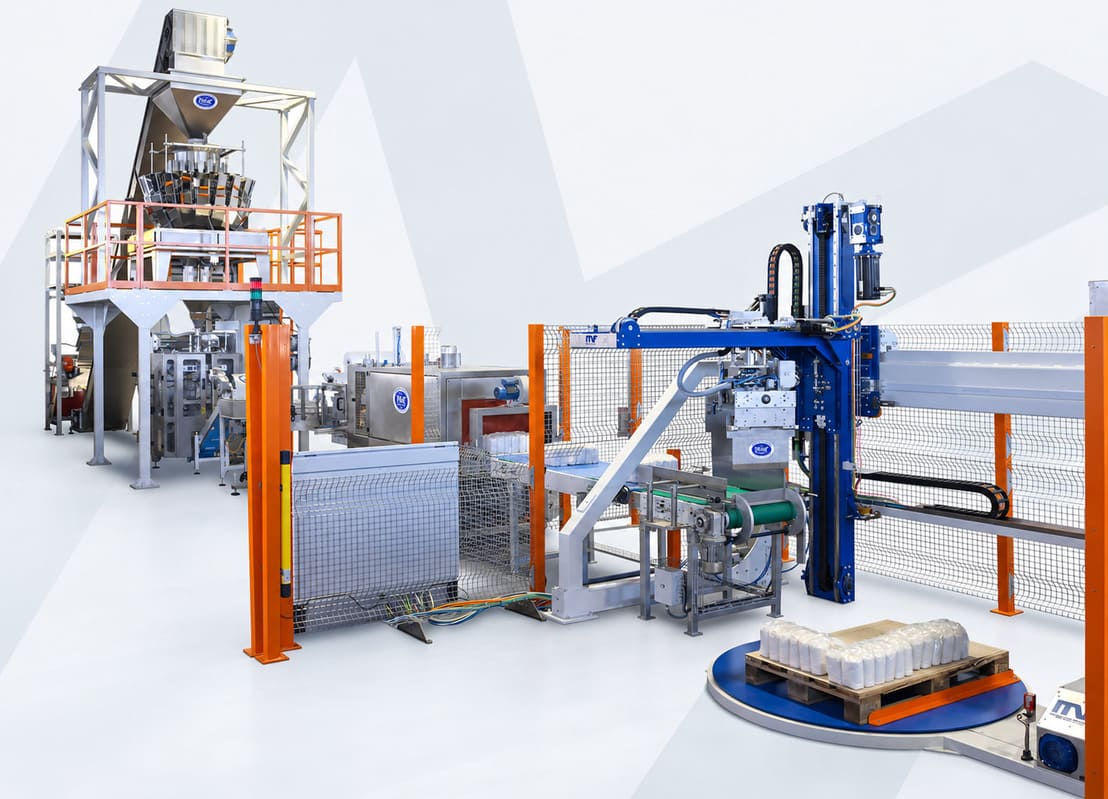
Packaging plant for abrasive materials
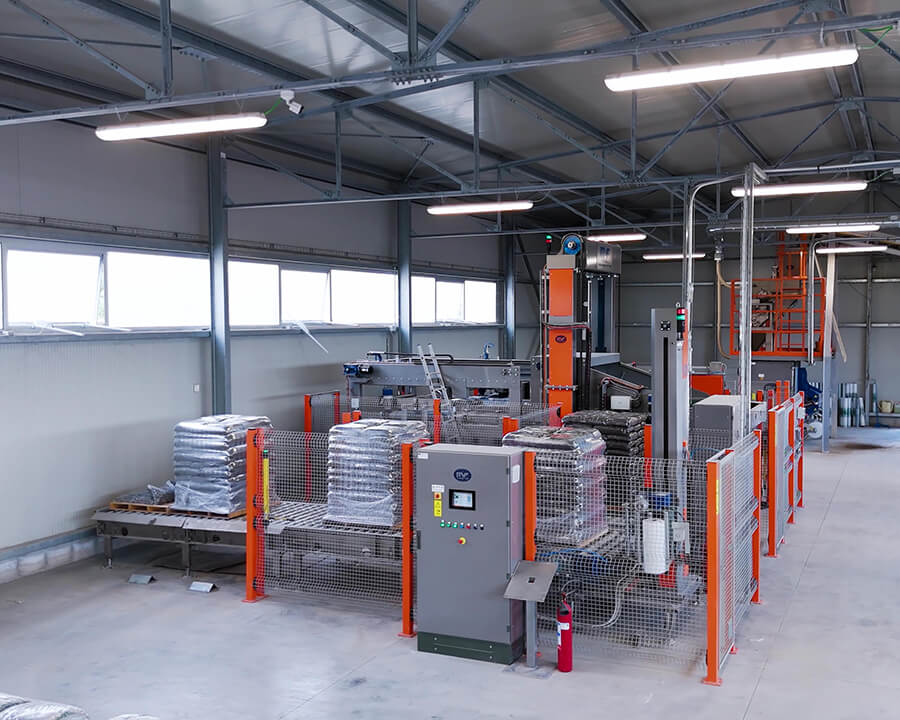
In the packaging of abrasive construction materials such as gravel, pebbles and sand, the challenge is not reaching the required production speed. It is maintaining it over time, across multiple shifts, without constant abrasion compromising bag quality or forcing unplanned stoppages. MF TECNO responded with a complete industrial packaging line for Agrisac, fully designed and built in-house.
Project overview | Customer | Agrisac |
| Product | Gravel, Pebbles, Sand |
| Operating speed | 1,000 bags/hour |
| Bag size | 20-25 kg |
| Daily capacity | Up to 8,000 bags/day |
| Daily output | Up to 240 tons/day |
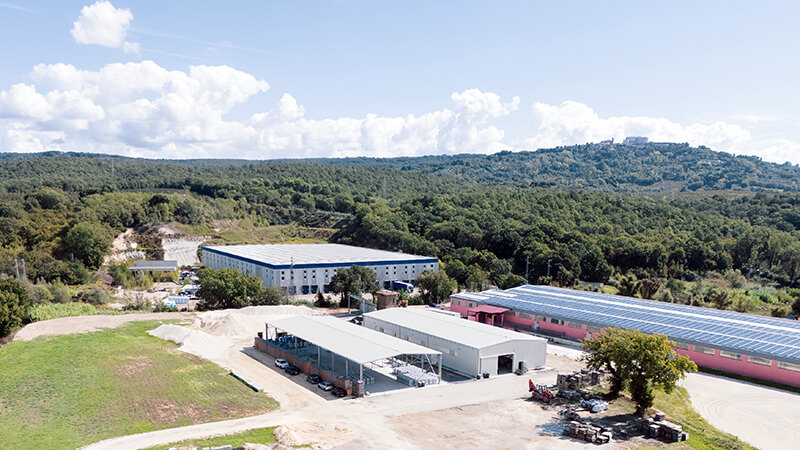
The technical challenge: wear, dust, production continuity
Inert materials generate constant friction and impact stress during dosing and transfer. The presence of moisture increases mechanical aggressiveness and accelerates the degradation of metal components. In a high-intensity production plant, these factors directly affect three variables that every plant manager and technical manager knows well: maintenance frequency, downtime and consistent packaging quality.
A second problem, often underestimated, concerns fine dust in the sealing area. Particles settling on the seal before heat-sealing prevent a homogeneous joint from forming, producing micro-leaks invisible to the naked eye but detectable under pallet pressure or during transport.
The solution: reinforced architecture and a fully in-house line
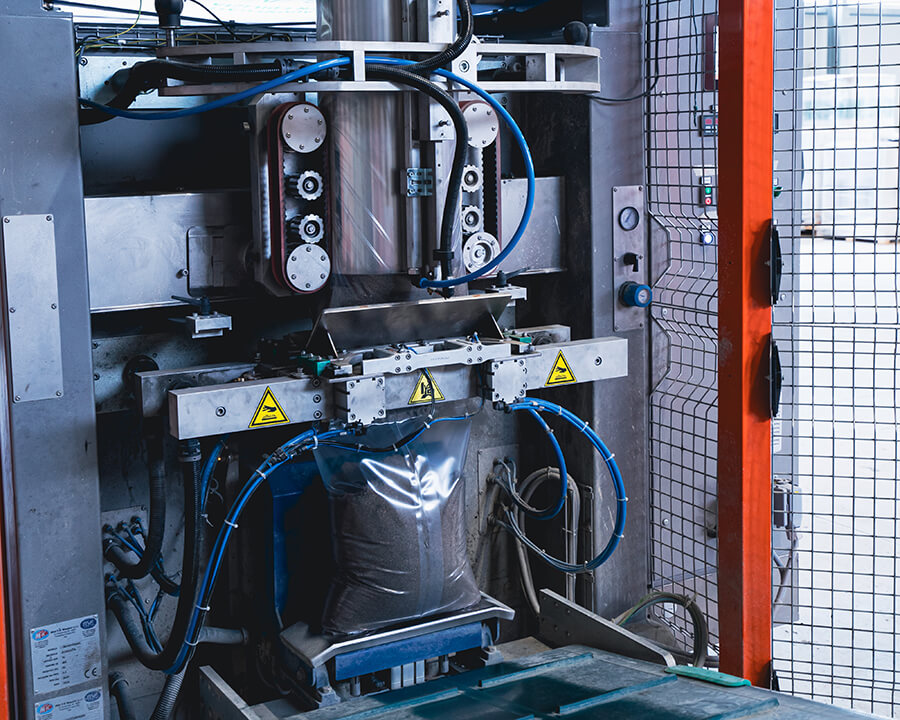
MF TECNO configured the vertical packaging machine MF 54 with specific modifications for abrasive materials: elastomeric surfaces on all product-contact parts, hopper with anti-wear linings, reinforced cross-sealing unit and brushless motor for cycle stability. A dedicated dust evacuation module, positioned before heat-sealing, eliminates seal contamination.
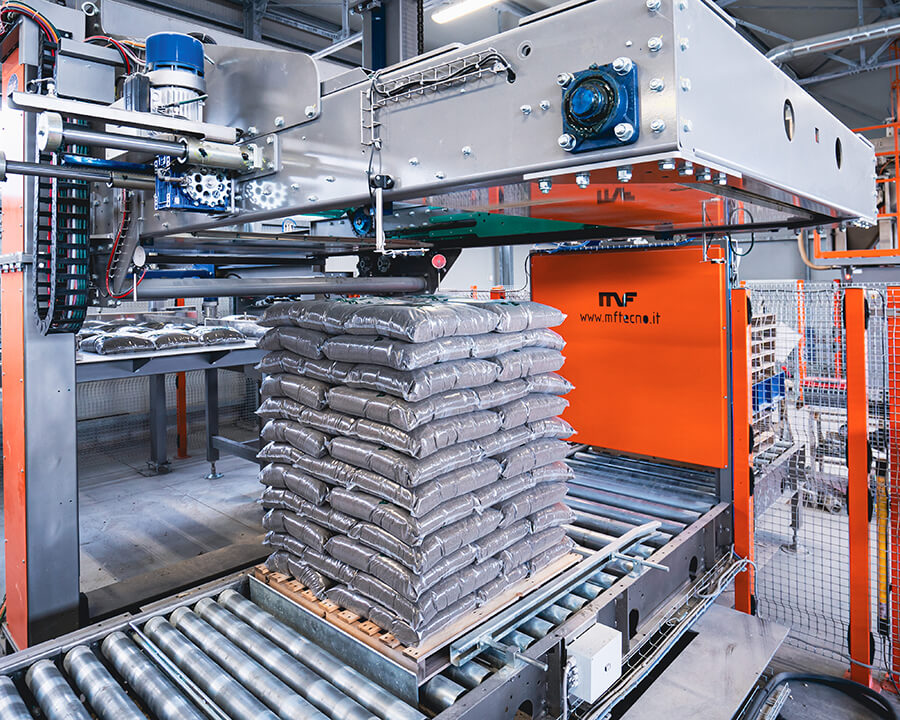
Downstream, the push palletizer handles high-density bags building pallets of 12 layers of 6 bags each. The MF Wrap 35 automatic wrapper completes the line with controlled pre-stretch for load stabilization.
The packaging machine, palletizer and wrapper are designed and built in-house. This eliminates compatibility issues between components from different suppliers and guarantees a single point of contact for machinery, technical support and spare parts: the concrete condition for reducing response times when intervention is needed.
Results
- Consistent production rate of 1,000 bags/hour across multiple cycles, with no performance degradation over time.
- Reduction in unplanned downtime thanks to a predictive maintenance-oriented layout: wear-prone components are directly accessible.
- Stable sealing quality even in the presence of fine dust, thanks to the evacuation module integrated before heat-sealing.
- Simplified management of the entire line with a single point of contact for technical support and spare parts.
FAQ: Frequently asked questions
1) How can wear be reduced in a vertical packaging machine working with abrasive materials?
The most effective solutions act directly on product-contact surfaces. Elastomeric linings on internal parts, hoppers with anti-wear protection and reinforced sealing units reduce the rate of mechanical degradation even during extended production cycles. A brushless motor for film feeding adds cycle stability and reduces tension variations that, over time, accelerate component wear.
2) What are the most common causes of sealing defects when bagging inert materials?
The main cause is contamination of the sealing area by fine dust generated during dosing and material transfer. Particles settling on the seal before heat-sealing prevent a homogeneous joint from forming, producing micro-leaks invisible to the naked eye but detectable under pallet pressure or during transport. A dust evacuation module positioned immediately before heat-sealing is the most direct technical solution to eliminate this issue.
3) Why is it advantageous to have a single supplier for the entire packaging line?
With a line assembled from different suppliers, every breakdown raises a question of responsibility before it even becomes a technical intervention. Longer response times, not always compatible system interfaces and separate spare parts management increase operating costs and make it difficult to apply a coherent predictive maintenance logic. A single supplier who designs and builds the packaging machine, palletizer and wrapper knows every component and every process parameter: this translates into faster diagnoses, targeted interventions and support management that covers the entire line, not just a single machine.
4) What is the real impact of unplanned downtime on a line running at 1,000 bags/hour?
On a line running at this production rate, every hour of downtime equals 1,000 bags not produced. In a plant operating two shifts, even two or three one-hour stoppages per month translate into thousands of lost bags and a cost that accumulates shift after shift. Predictive maintenance, made possible by a layout that keeps wear-prone components directly accessible, is the most effective tool for keeping this cost under control.
5) Is a push palletizer the right choice for bags of construction materials?
Yes, for bulk inert materials a push palletizer is particularly suitable. High-density bags with low internal air content, typical of these products, lend themselves to compression during stacking and provide greater pallet stability. Compared to other systems, this configuration handles the weight and compactness of the load better, producing geometrically consistent pallets that withstand the stresses of storage and transport.
6) How do you evaluate the durability of a packaging line for abrasive materials?
The relevant parameters are not just speed or production capacity, but those related to long-term performance: maintenance frequency, average service life of product-contact components and mean time to repair after a breakdown. A line designed with reinforced architecture and a predictive maintenance-oriented layout shows a much flatter degradation curve than a standard line, with contained operating costs and consistent production performance even after thousands of hours of operation.


 FREE QUOTE
  Machinery













 Request information