Anyone packing bulk products in bags from 5 to 50 kg often faces a crossroads: choosing between form-fill-seal machines and open-mouth bagging machines. But which is the right solution for your investment, and when does a tubular bagging machine make more sense?
There is no single best technology. The right choice depends on several key factors: the production volumes you need, the bag material, the characteristics of the product and how often you change format. Each of these machines has its own features that make it more or less suited to a given project and to the customer's real needs.
In this article we look in detail at the differences between the two technologies, with a practical guide to help you choose based on all the parameters that matter.
The comparison at a glance
| Criterion | FFS tubular bagging machine (MF TUBE) | Open-mouth bagging machine (IABA, UNIVERSAL) |
| Bag origin | Formed in the machine from a tubular reel | Pre-made bag from the bag magazine |
| Maximum output | Up to 1,800 bags/h | From 600 to 1,500 bags/h depending on the model |
| Bag weight | Up to 50 kg | Up to 50 kg |
| Bag size | From 320 × 480 to 480 × 900 mm | From 180 × 400 (gusseted) to 600 × 1,100 mm (flat) |
| Material | PE, COEX, barrier or micro-perforated film on reel | Paper, aluminium-lined or PE-coated paper, PE, PP, laminated or woven raffia |
| Bag types | Tubular film, pillow or gusseted | Flat, gusseted, pillow, pinch-top, pouch, with handles |
| Closure | Heat sealing, including 45° corner sealing (K-seal) | Sewing, crepe paper tape, heat or impulse sealing, pinch-top |
How an FFS tubular bagging machine works
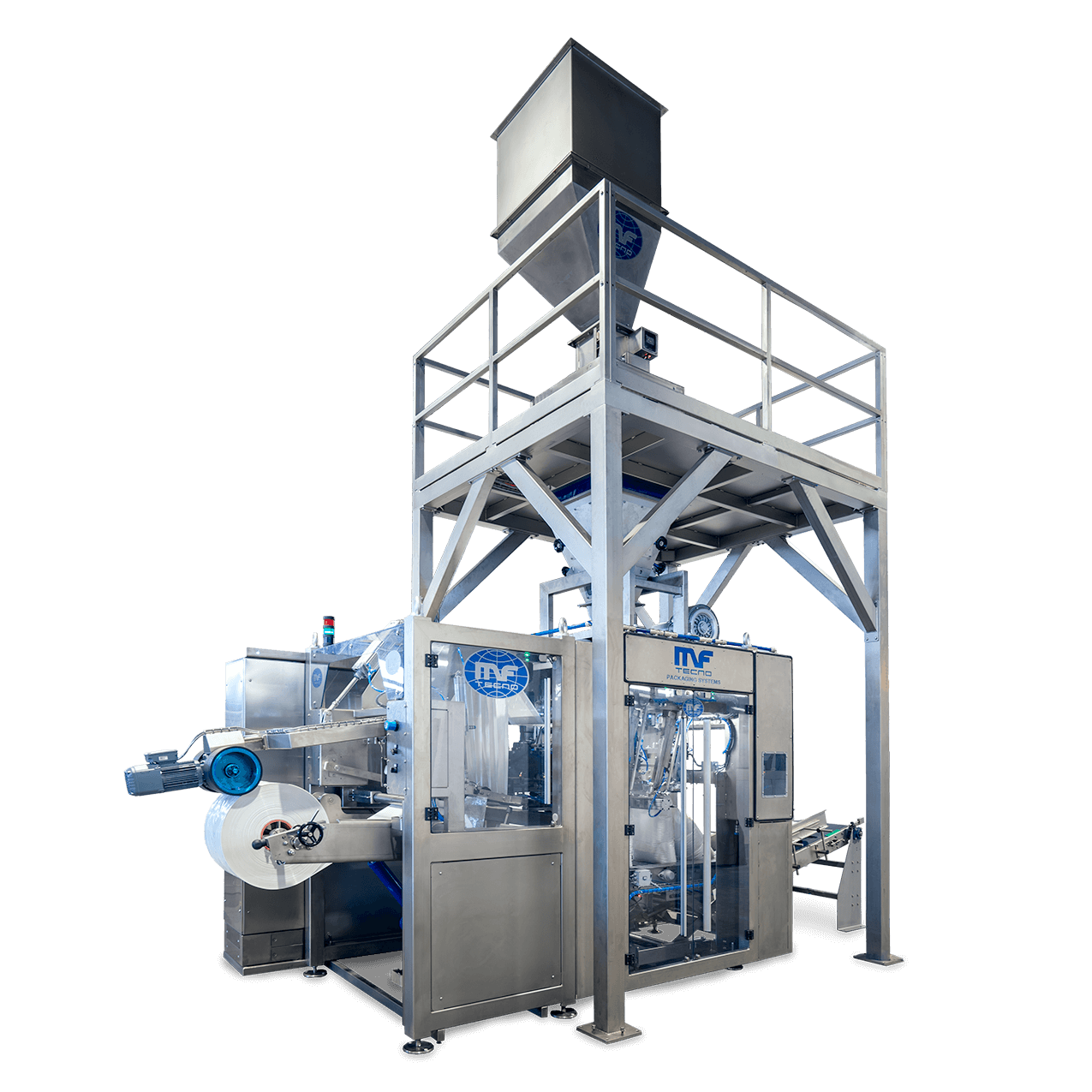
FFS (Form, Fill & Seal) technology combines bag forming, filling and sealing in a single automated cycle, starting from a reel of tubular film.
The MF TUBE works on three operating stations running simultaneously:
- Station 1 – Forming: the film is cut to length and the bottom is sealed.
- Station 2 – Filling: the bag is filled with the weighed product.
- Station 3 – Closing: the top of the bag is sealed.
Key strengths of the MF TUBE
- Maximum hygiene and durability: the AISI 304/L stainless steel structure makes cleaning easier and is ideal for food products or highly corrosive materials.
- High performance in a small footprint: the ultra-compact design allows integration even in tight layouts, with outputs of up to 1,800 bags/hour.
- Customisation and efficiency: it can be fitted with pre-sealing flap cleaning systems and direct-on-film printing modules.
How an open-mouth bagging machine works
An open-mouth bagging machine picks a pre-made bag from the bag magazine, opens it and places it under the filling spout, where it is filled with the weighed product and sent on to the closing station.
On the IABA 800 S, for example, the three-position automatic bag magazine includes a rotary bag picker that opens and presents the bag in a single step.
A chain conveyor carries the filled bag to the final closing system, which can be configured for the application: plain or folded sewing, crepe paper tape, heat or impulse sealing, or pinch-top closure.
To optimise volume, devices such as bag vibration, a de-aeration probe and an air-extraction system compact the product before sealing.
The factors that drive the choice
Choosing between an open-mouth bagging machine and an FFS tubular bagging machine comes down to which technology best meets the specific needs of your plant. To identify the most suitable and efficient solution, three key factors need to be analysed in detail:
- Output: the packing speed required and the hourly volumes to be reached.
- Format flexibility: the range of weights to be handled and how often the format changes.
- Bag materials: the type of material (PE, paper, polypropylene) and the type of closure required.
Let's look at each of these in detail to see which machine best meets each requirement.
Output
Tubular bagging machines and open-mouth bagging machines cover different speed ranges depending on their configuration.
The FFS reaches up to 1,800 bags/h on a single line. Among open-mouth bagging machines for formats over 5 kg, the twin-station IABA 600 D reaches 1,500 bags/h, while the single-station versions range from 600 bags/h on the IABA 600 to 1,200 bags/h on the UNIVERSAL 1200.
Above 1,500 bags/h the choice tends to lean towards the tubular bagging machine, while below that threshold the boundaries between the two technologies become flexible and the decision is driven by operating and layout factors.
Actual output always depends on the type of product being handled (powders, by their nature, need more time for de-aeration and compaction).

Formats
In terms of formats, open-mouth machines offer a very flexible range: they can handle flat bags up to 600 × 1,100 mm and gusseted bags from 180 × 400 mm, with bag weights from 2 kg (on the UNIVERSAL 1200) up to 50 kg.
FFS technology, on the other hand, handles bag sizes from 320 × 480 to 480 × 900 mm.
While open-mouth machines require pre-made bags, the FFS system works from the reel, so bag length can be set and changed directly from the machine panel.
Bag material
This is often the deciding factor. FFS technology uses plastic film from the reel (such as PE, co-extruded films, barrier films for products sensitive to oxygen or moisture, or micro-perforated films that let air escape).
Open-mouth bagging machines can handle a wider range of materials, including paper, aluminium-lined paper, PE-coated paper, PE, PP and laminated raffia, and on some models woven raffia too.
Where the market requires a paper bag (as is common for flour, animal feed and pet food), the choice is made for you.
Product, bag sealing and end of line
Product type. Both technologies handle free-flowing, granular and powdery products. With the bag sealed on all sides, the FFS gives good protection to products that are sensitive to moisture or stored outdoors for long periods, such as fertilisers and plastic granules. Open-mouth machines are better suited to powders: the IABA 600 D, for example, has bag vibration and a de-aeration probe and handles up to 1,000 bags/h of powders such as flour, milk powder, talc and cement.
Sealing. The FFS bag is heat-sealed and therefore hermetic. On open-mouth machines, the seal depends on the closure: heat sealing and pinch-top seal the bag, sewing does not.
Palletising. The 45° K-seal on the MF TUBE gives the bag sharp corners and a regular shape, making the pallet more stable. Both technologies connect to MF TECNO palletisers, from the MF PCA SMART (up to 500 cycles/h) to the MF PRC 1000 (up to 1,200 cycles/h), and to pallet wrappers.
Sustainability. A PE-only FFS bag is mono-material and therefore easier to recycle; co-extruded and barrier films need to be assessed case by case. Open-mouth machines let you choose paper when the end customer asks for it.
How to choose
In short: FFS pays off when you need high volumes in a polyethylene bag; open-mouth when you need different materials, different formats or a paper bag.
| If your situation is... | Go for | MF TECNO reference model |
| Over 1,500 bags/h of a single product, PE bag | FFS tubular bagging machine | MF TUBE |
| Hermetic bag for hygroscopic products or outdoor storage | FFS tubular bagging machine | MF TUBE |
| The market requires paper or raffia bags | Open-mouth | IABA 1000, UNIVERSAL 1200 |
| Many different formats, from 2 to 50 kg, or pinch-top bags and bags with handles | Open-mouth | UNIVERSAL 1200 |
| High-output powders | Twin-station open-mouth | IABA 600 D |
| Medium outputs up to 600–800 bags/h | Open-mouth | IABA 600, IABA 800 S |
Examples by industry
- Animal feed and pet food: open-mouth bagging machines are used with paper bags or bags with handles for retail, while FFS technology is rarely used, mainly because of the look of the bags.
- Fertilisers: FFS is common thanks to its combination of high output and excellent moisture resistance of the bag.
- Chemicals and plastic granules: FFS is well suited to packing granules, while open-mouth machines are used for powdered detergents.
- Minerals and aggregates: open-mouth machines handle products such as cement, talc and clay in paper bags effectively; FFS is used for sand and mortar packed in PE.
- Pellets and fuels: both technologies are suitable; the final choice depends on the type of packaging required by the distribution chain.
FAQ: Frequently asked questions
1) Which technology is more flexible when changing format?
It depends on what changes. With FFS the bag is formed from the reel, so its length is adjusted directly from the machine panel, with sizes from 320 × 480 to 480 × 900 mm.
Open-mouth machines cover a wider range of formats and bag types: flat bags up to 600 × 1,100 mm, gusseted bags from 180 × 400 mm, pillow, pinch-top, pouch and bags with handles, with bag weights from 2 kg (UNIVERSAL 1200) to 50 kg.
To change format, however, you need pre-made bags of the right size in stock. Companies packing many products in different packs usually find open-mouth the more versatile solution.
2) Which bag gives the best seal?
The FFS bag is sealed on all sides and therefore hermetic: it gives good protection to hygroscopic products or products stored outdoors for long periods, such as fertilisers and plastic granules.
On open-mouth machines, the seal depends on the closure chosen: heat or impulse sealing and pinch-top closures seal the bag, sewing does not.
If moisture protection is the priority, choose FFS or an open-mouth machine with a sealed closure.
3) Which of the two solutions is more sustainable?
It depends on the bag material. A PE-only FFS bag is mono-material and therefore easier to recycle, while co-extruded and barrier films need to be assessed case by case.
Open-mouth machines, on the other hand, let you use paper when the end customer asks for it. The most sustainable solution is the one that balances product protection, the recycling chain and market requirements.
4) Do the machines integrate with the rest of the line?
Yes. Both technologies integrate with MF TECNO net-weight scales, palletisers and pallet wrappers, from the MF PCA SMART (up to 500 cycles/h) to the MF PRC 1000 (up to 1,200 cycles/h).
The MF TUBE has an added advantage: the 45° K-seal gives the bag sharp corners and a regular shape, making the pallet more stable. At the design stage it is worth assessing the bagging machine and the end of line together, to balance outputs and avoid bottlenecks.


 FREE QUOTE
 Machinery













 Request information
